

Sacred Friendships: How they save us from the Tyranny of our Inner Critic...and help us Shine
Radiance Code 19: I nurture my inner circle of sacred friendship that helps me remember my own radiance through every season of life.

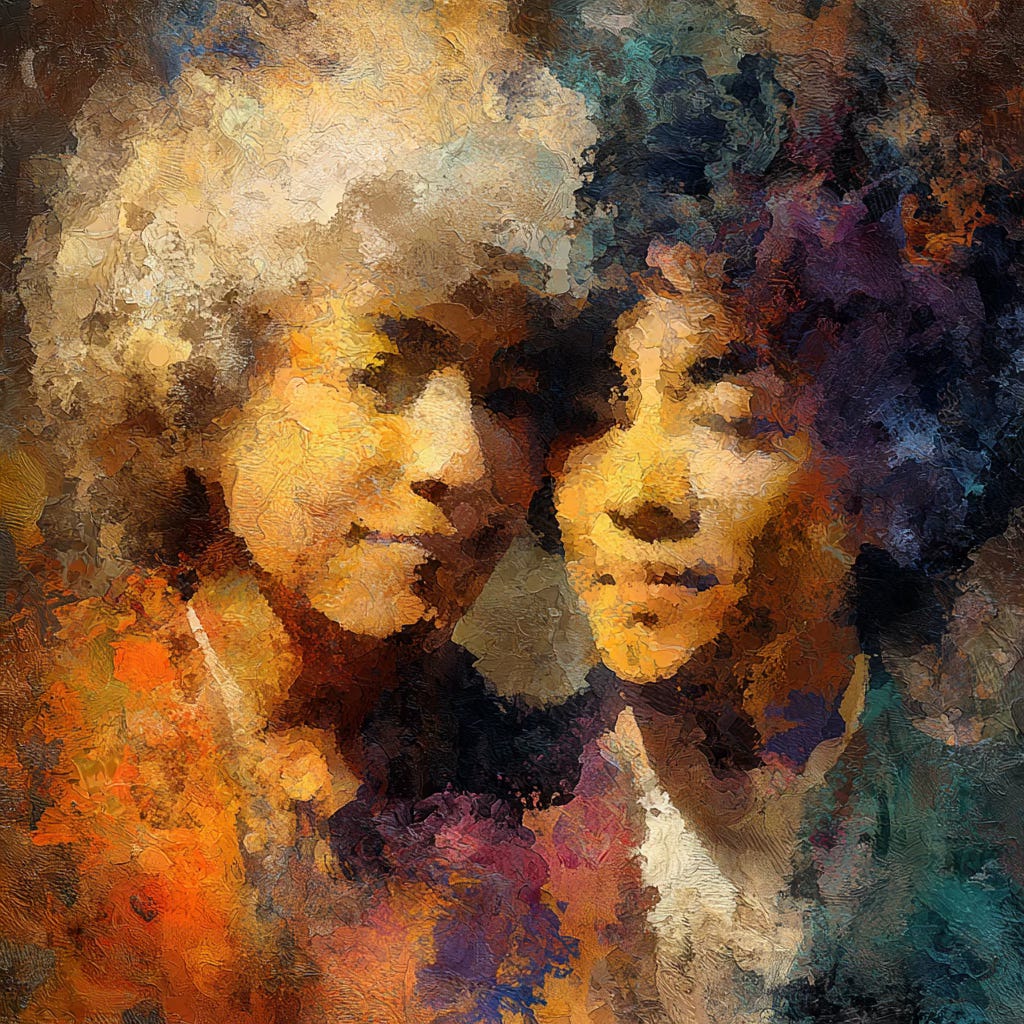
Recently, I was asked some great questions recently about the topic of friendship —by a “sacred friend.” Her questions were very thoughtful, including about how we and our friendship have evolved (over many decades) and continues to evolve. I was deeply moved by the tenderness and quality of her queries — and that we had more terrain of “knowing” between us yet to explore, which felt exciting. So, I’ve been nursing some thoughts about friendships, in particular, what I call “sacred” friendships, resulting in this post.
By the way, when I refer to “sacred,” I am NOT using it in a religious context. In the context of relationship, for me, “sacred” means: a quality operating at an elevated level of regard, care, devotion and appreciation coupled not only with love, but also with a transcendent sense of wonder — because of the way we are enlivened, felt and inspired by its presence.
The Friends Who Carry Our Becoming
If we pause long enough to really consider the friendships that have endured in our lives, we begin to notice something deeper than shared history or mutual affection. We begin to see continuity. We begin to feel the presence of people who have, in quiet and faithful ways, carried pieces of us across time.
Some of these friendships began early, when we were still discovering who we were, before life asked us to define ourselves or refine our edges. These women remember us in a way no one else can. They hold a version of us that existed before the world shaped us into roles, responsibilities, and expectations. And when we are with them, something in us softens. We do not have to reconstruct ourselves. We are already known.
Others entered our lives later, in moments when we were already becoming—through work, through love, through challenge, through reinvention. They met us in motion. And yet, something in them recognized us clearly enough to stay. These friendships are not built on origin, but on resonance. They are chosen, often without announcement, through a quiet knowing that says: you see me, and I see you.
And then there are those closest friendships—the ones woven into the fabric of our daily lives. The ones where conversation flows easily, where laughter comes without effort, where silence is not awkward but understood. These are the relationships that move with us, that hold us in real time, that remind us who we are not only across years, but in the middle of an ordinary day.
When we look at this circle as a whole, we begin to understand that it is not simply a collection of relationships. It is a field. A place where we are seen, remembered, and held in ways that allow us to return to ourselves more easily.
Sacred Friendship as Witness and Mirror
There is a particular feeling that lives inside a sacred friendship. It is the feeling of being known without having to explain yourself from the beginning.
In these relationships, we’re not performing. We’re not curating. We’re not trying to be consistent in ways that flatten who we are. Instead, we’re allowed to be in motion—to change, to grow, to contradict ourselves, to find our way and lose it again—without losing our place in someone’s regard.
A sacred friend doesn’t hold us to a fixed version of who we have been, nor do they withdraw when we are uncertain. They make room for us. They trust our becoming, even when we are still inside it.

And there are moments—very real moments—when our own inner voice becomes too loud, too critical, too certain in the wrong ways. We begin to believe things about ourselves that are not entirely true. We tighten. We overthink. We lose perspective.
This is where friendship becomes something more than companionship.
A sacred friend reflects us back to ourselves—not as we fear we are, but as we actually are. Through their presence, their words, or sometimes simply their way of being with us, something inside begins to recalibrate.
We remember. We soften. We come back.
Sometimes, we borrow our clarity from the people who love us.
And in that sense, friendships do something essential. They save us, at times, from the tyranny of our own inner voices.
Our “Besties:” Where We Are Fully Accepted
There are certain friendships that deepen beyond all categories. We may call them “best friends,” but the language rarely captures the depth of what is actually present.
Very often, these bonds begin early—childhood or adolescence—when we are at our most tender in shaping a sense of self, and when so much of that shaping happens through how we’re received by others. To be liked, to be chosen, to be appreciated simply for being who we are—before we have learned to curate or defend ourselves—is no small thing. It can land as recognition. It can feel like permission. It can quietly anchor a young person’s sense of worth.
At that stage, the pull toward a best friend can be intense and all-encompassing. There is a natural longing for closeness, for allegiance, for someone who feels like “my person.” Promises are made with a kind of seriousness that only youth can hold—vows of always being best friends, no matter what. And while life inevitably introduces distance, change, and new chapters, it is remarkable how often the essence of that vow endures. Something in the bond remembers. I know this.

As these friendships mature, what began as closeness evolves into something more resilient and consciously held. These are the relationships where we are seen raw and unfiltered, where very little needs to be hidden or managed. We can arrive exactly as we are—uncertain, emotional, strong, joyful, undone—and still feel fully received.
These friendships are not built overnight. They are formed through time, through trust, through the quiet accumulation of moments where we show up for each other and discover that the relationship can hold more than we initially expected.
There is a kind of faith that develops here. Not blind faith, but earned trust. Confidences are shared without conditions. The understanding that we can be honest, that we can be challenged, that we can disagree, and still remain connected.
These relationships are often both tender and strong. They can hold softness and truth at the same time. They can withstand tension without breaking. They do not rely on perfection to endure, but on a shared commitment to stay, to repair, and to continue choosing one another.
And within them, something rare becomes possible.
We experience a kind of unconditional love that is not dependent on being at our best. We are known in our fullness—and still loved.
Finally, I don’t believe that a “Bestie” is singular — that we only have one. Sacred friends can become besties in the moments and phases of life that you engage, and can remain there ever more, or fade or reappear in the contexts and versions of yourself where they are called by you or where they love to show up for you. There is something so remarkable about full “presence” with a sacred friend that can be transformed into yet higher levels of trust, faith and commitment.
If you pause for a moment and consider your own life, you may ask yourself:
Who are the people with whom I can be fully unfiltered?
Where in my life do I feel most deeply known?
And just as important—where am I offering that same level of presence and trust in return?
Forged in Fire: The Bonds of Intensity and Passage
There are also friendships that ignite during the most concentrated seasons of our lives—high school or college environments where identity is being tested in real time, demanding workplaces or competitive arenas where intensity is shared daily, or life passages marked by loss, divorce, illness, spiritual seeking, or a powerful sense of purpose. They keep burning long after.
In these moments, the commonality of experience can be so immediate and encompassing that it creates a rapid intimacy. We find ourselves drawn to those who truly understand what we are living through, not in theory, but from within it.
What is forged in these periods becomes its own category of bond. These relationships are not always numerous, but they are distinct. The trust forms quickly, yet it is not shallow. It is shaped by shared pressure, shared vulnerability, and the relief of being recognized without explanation.
A recent example from my own life. One of my “Besties” since teen-hood endured and lost a long battle with cancer — in another country. I spent much time with her and got to meet and spend time with other beloved friends of hers, who often gathered to support her as well. We created a chat group and this new sacred circle lives on, dedicated to the aliveness our friend brought out in us each. I now get to celebrate and deepen these friendships, including traveling there, to further explore these gems and their facets.
There is something about having walked through an intense passage alongside another person that creates a lasting imprint. Even as life moves on and circumstances change, the connection often retains a quiet reliability, because it was formed at depth from the very beginning.
If you reflect on your own life, you might ask:
Where have I been deeply seen in a time of intensity or transition?
Who understands me because they were there with me, not just for me?
These friendships, though different from the long arc of “besties,” become anchors in their own right—holding a shared truth that does not need to be revisited to remain real.
No Friend Sees and Understands us Completely, But....
Each of us is like a faceted jewel, reflecting different qualities depending on the light, the angle, the moment, and the relationship itself. With one friend, a certain ease of laughter comes forward. With another, a depth of reflection. With another, a shared history that brings out a particular tenderness or familiarity. These are not performances or partial truths. They are real expressions of who we are, revealed in context.

Our friends come to know us through the versions of ourselves that are most alive within the spaces we share with them. Over time, they recognize and celebrate certain facets—qualities, memories, energies—that may not be as visible in other relationships. And in turn, we experience them through the facets they reveal to us.
This does not diminish the connection. It enriches it. It means that across our circle, we are known in a more complete and dimensional way, even if no single person holds the entirety.
If we consider this gently, it can also release a quiet pressure—the idea that we must be fully understood in every relationship in order for it to be meaningful. Instead, we can allow each friendship to hold what is true within it, trusting that across the whole, we are seen in many ways.
And perhaps this is part of the beauty: that we can shine, fully and sincerely, in different ways with different people, and still remain wholly ourselves.
When Friends Become Family, and Family Becomes Friends
There is another distinction that begins to matter in reflecting more deeply on the relationships that shape our lives: the difference between those we choose and those we are born into—and the meaningful ways those boundaries can soften over time.
Friendship, at its core, is chosen. It is an act of recognition, of resonance, of mutual willingness. We are drawn toward certain people, and over time, through shared experience and trust, we decide—sometimes consciously, often quietly—that this relationship matters, that it will be tended, that it belongs in our lives.
Family, by contrast, is not chosen. It is given. It arrives with history, with roles, with expectations both spoken and unspoken. And because of that, it does not always begin as a space of ease, clarity, or deep emotional alignment.
But something important becomes possible over time. Within family, we can begin to cultivate friendship.
This does not happen automatically. It requires a shift—from obligation to willingness, from assumption to curiosity, from inherited roles to genuine relationship. When that shift occurs, something softens. We begin to see one another not only as parent, sibling, cousin, or in-law, but as individuals with their own interior lives, their own perspectives, their own becoming.
And in that seeing, a different kind of connection can emerge.
A family member can become a sacred friend.
The relationship begins to carry qualities of choice, of trust, of mutual regard. Conversations deepen. Listening becomes more present. There is less need to perform a role, and more space to simply relate.
For me, my half-sister became my Bestie, even though we started to really know each other when I was in college. She helped me weather my college years and beyond as both big sister and devoted friend. By the time I was in mid-life, I realized that my father had become such a sacred friend too— no one could see me and share that wisdom as he did, and regard and encourage my personal sovereignty with grace and support. Now, my niece has become a Bestie. There is nothing I can’t share with her —and not feel my own radiance returned.

At the same time, there are friendships that, over the years, take on the feeling of family. Not through obligation, but through continuity, care, and shared life. These are the people who are present across milestones, across seasons, across the ordinary and the significant. They are the ones we call instinctively, the ones who feel woven into the structure of our lives.
In this way, the distinction between friendship and family begins to blur—not by losing its meaning, but by expanding it.
There are moments in life when this becomes unmistakably clear. In times when challenges feel almost unbearable—when we are depleted, overwhelmed, or carrying something too heavy to hold alone—it is often our sacred friends who step forward in ways that feel profoundly familial. They show up. Not occasionally, but consistently. Not superficially, but with depth.
They offer care that is tangible. They offer presence that steadies. They offer reassurance that does not waver with circumstance. And perhaps most importantly, they stay.
In those moments, the language of friendship can feel too small. What we experience is something closer to chosen family—bonds that are not defined by origin, but by devotion, by reliability, and by the willingness to remain when it matters most.
We come to understand that what makes a relationship feel like family is not simply origin, but depth. Not simply history, but presence. Not simply connection, but care that endures.
If we reflect on our own lives, we might gently ask:
Where have I allowed a family relationship to deepen into true friendship?
Which friendships in my life carry the feeling of family?
And where might there be space for something to soften, to open, to become more real?
Because over time, one of the quiet gifts available to us is this: To choose our friends, and to grow into friendship within our family.
The Men Who Can Stand in the Circle of Women
There are also men who find their place within a circle of women—men whose presence is grounded, steady, and respectful in ways that allow for true friendship.
These are not relationships built on expectation or subtle control, but on a genuine capacity to meet one another clearly. There is no need to perform, no need to explain excessively, no need to guard against being misunderstood.
In their presence, we feel seen rather than evaluated, understood rather than interpreted. And that allows for a different kind of ease. These friendships may be less common, but when they are present, they add depth and dimension to the circle in meaningful ways.

I have several strong male friendships over decades which have given me wonderful perspectives and much laughter emanating from amazing shared, ideated spaces. They also form my sacred friend circle.
Different Lives, Shared Values
One of the quiet strengths of sacred friendship is that it does not require us to live the same life in order to remain deeply connected.
We may make very different choices—about partnership, family, work, or lifestyle—and still feel a profound sense of alignment. Because what binds these friendships is not circumstance, but values. A shared way of seeing. A shared depth of feeling. A shared commitment to living with integrity.
This allows the relationship to breathe. It allows each person to evolve without fear of losing connection. It allows love to remain steady, even as life unfolds in different directions.
How Sacred Friendships Weather Change
If we stay in any friendship long enough, we begin to encounter the reality of change—within ourselves, within the other person, and within the circumstances of life that shape us both.
There may be periods of distance. Seasons where we are out of touch, not out of lack of care, but because life has pulled us into different rhythms, different responsibilities, different inner landscapes.
And yet, there is a way of knowing when a friendship is sacred. The distance does not diminish it. Time does not erode it.

When we come back together, something is instantly recognizable. The connection revives—not artificially, not through effort, but naturally. As if it had been quietly waiting, intact, beneath the surface of time.
At the same time, there are moments when change reveals something more complex. A friend may evolve in ways we did not expect. Differences that once felt small or invisible may become more pronounced. What we once moved through easily may now feel slightly misaligned or even challenging.
These moments ask something of us. Not immediate resolution. Not judgment. But presence.
They invite us to slow down, to let the relationship breathe, and to meet the other person where they are now, rather than where they used to be, or how you used to see them. Our friends are not expected to remain static or stuck in some version of our own perceptions, memories or experiences. We change too. How we perceive changes also.
In a sacred friendship, love does not disappear in these moments. It remains. What changes is how we hold one another. We hold it with more tenderness. With more spaciousness. With less need to correct or define. And most importantly, without judgment.
Because at its core, what I’ve really learned is that sacred friendship is not a place where judgment resides. It is a space where we are allowed to be human, to evolve, to shift, and still be met with a fundamental regard that does not withdraw. It must remain a sacred space of mutual trust.
If you reflect on your own friendships, you might ask:
Where has time or distance tested the connection—and what remained?
Where am I being invited to soften my grip and meet someone as they are now?
And what does it feel like to hold a friendship not with expectation, but with quiet, enduring love?
The Inner Circle We Need
It is easy to think of friendship as something that enhances life, something we are fortunate to have if time and circumstance allow. But if we look more closely, we begin to see that certain friendships are not optional.
They are stabilizing. They are clarifying. They are, in so many ways, sustaining.
There are things we cannot see clearly on our own. There are moments when our thinking tightens around a single perspective, when our emotions narrow our field of view, when we lose access to the broader truth of who we are.
In those moments, the presence of a trusted friend can shift everything. Not by telling us what to do, but by offering a different way of seeing. By holding space long enough for something inside us to reorganize.
And over time, we begin to understand that this is not one-sided. We are doing the same for them. We are holding, reflecting, steadying, and reminding.
This is what makes the inner circle so essential. It is not about dependency. It is about mutual clarity. It is about having spaces in our lives where we are both supported and seen.
Weaving the Circle Together
Some of us feel a natural desire not only to hold these friendships individually, but to bring them into shared space. Like me.
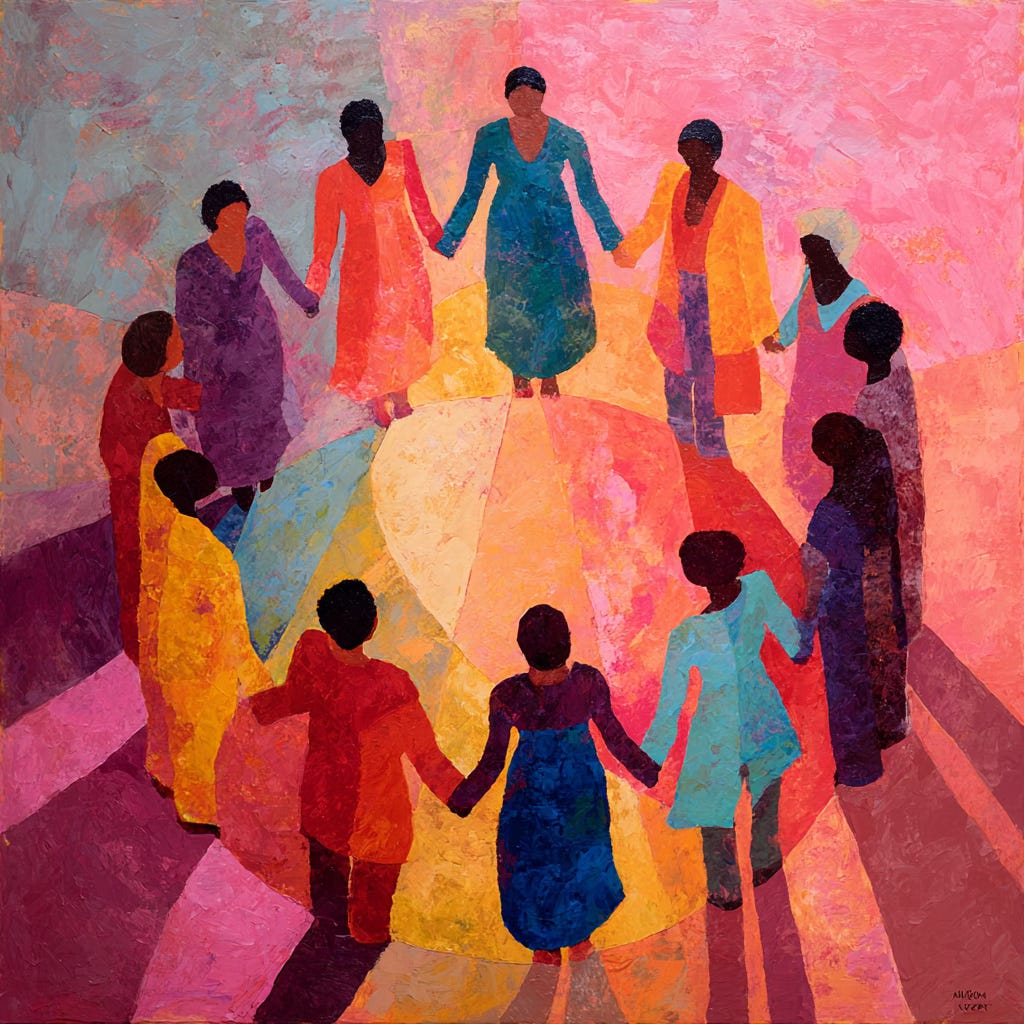
I love to gather the people I love. To let them meet. To allow them to become aware of one another—not as names we mention in passing, but as real presences in my life.
There is something deeply meaningful about this. When the people who matter to us begin to recognize one another, something becomes more whole. Our relationships are no longer separate threads. They begin to form a fabric.
Within that fabric, connection expands. Conversations deepen. Unexpected affinities emerge. The circle begins to hold itself, not just through us, but through the shared awareness growing within it.
If this resonates, you might ask:
Do the people I love know each other, even in simple ways?
Is there space in my life to bring my circle together, to let connection widen beyond me?
Because over time, we may come to feel what is true here: The circle is not only for each of us. It is for all of us.
Radiance in Relationship
We often think of radiance as something we generate entirely on our own. And in many ways, that is true. But there is also something relational about it.
There are environments in which our radiance becomes easier to access, easier to feel, easier to trust. Sacred friendship is one of those environments.
In the presence of people who see us clearly, we do not have to try to be radiant. We simply are. And that recognition reinforces something inside us that might otherwise feel distant.
Tending What Matters
Not every friendship will deepen in this way. And not every relationship is meant to endure indefinitely.

But when we begin to recognize the ones that do carry depth, trust, and continuity, we are given an opportunity to tend them with intention.
To reach out. To make time. To stay connected beyond convenience. And to offer the same presence, care, and honesty that we value receiving.
A Gentle Return
At certain moments in life, we may feel slightly removed from ourselves. Not lost, but layered over by everything we are carrying.
And then we sit with a friend who knows us. We talk. We laugh. We are quiet. We say things we had not fully formed. And somewhere in that exchange, something shifts.
We recognize ourselves again. Not as we feared we had become, but as we have always been. And that recognition, simple as it may seem, is one of the quiet gifts of sacred friendship.
It brings us back.
A sacred friend does not let us dim our light. Their presence, their support, their spacious attentiveness, and their genuine love reflect something back to us that we may have momentarily forgotten.

They remind us of our radiance simply by seeing it and holding it without question. And over time, we come to understand that this is not something we only receive. We do this for them as well.
In this quiet exchange—this mutual recognition—we help keep one another fully lit.
A Few Gentle Invitations
If this resonates, you might take a moment to sit with your own circle and notice what’s already here.
Who are the people you would name as your sacred friends?
What do you feel in their presence?
What qualities in you seem to come alive most easily with them?
You might also consider the rhythm of these relationships.
How often are you truly in touch?
Is there a natural cadence that keeps the connection warm and current, or has it become more distant than you would like? If so, what might it look like to reintroduce a gentle structure—not rigid, but intentional? A simple check-in.
A quick text to say hello. A photo shared in the moment. A “remember when” that brings a smile and reconnects a thread.
And then there is the question of presence.
How often do you see your closest friends in person?
Is there space to plan something—a visit, a gathering, a shared experience—that allows you to be together more fully?
Sometimes, it is not the grand gesture that sustains a friendship, but the small, consistent acts of reaching toward one another. And sometimes, it is the willingness to create time—real time—to sit together, laugh, talk, and simply be.
You might ask yourself, gently: Where am I being invited to tend the friendships that matter most? And what small step could I take this week to keep that bond alive?

There are moments when we cannot hear ourselves clearly. And in those moments, a true friend becomes our clarity.
Because these relationships do not ask for perfection. They ask for Presence. And when we offer that, even in simple ways, something enduring continues to grow.
Still You Shine, Together.
Love,
Angelique
For more about the Still I Shine Emergence Codes and the Radiance Codes, I welcome you to explore prior posts.
How do you FLOW (Fully Live your Own Way) with meaning and purpose? Find out and take the EnteleKeys Reveal here. If you like the assessment, please heck out my new book: Unlock Your Potential with the EnteleKeys .

Thank you for spending time with me here!
Thanks Sharon...such an important revelation to cherish and I know you do!!
Angelique, this is absolutely incredible. Thank you so very much.🥰